
Industry Guide
Everything You Need to Know About Sesame Seeds
From the field to the global market
Sesame seeds are one of the oldest and most widely traded oilseed crops in the world. Native to the Indian subcontinent and sub-Saharan Africa, they have grown from a survivor crop for subsistence farmers into a global commodity that touches everything from bakery goods to premium cooking oils.
For those working across the sesame supply chain, a solid grasp of the crop’s fundamentals is essential. This guide covers four core areas: cultivation, post-harvest handling, market dynamics, and variety selection.
Sesame Cultivation and Field Management
Origins and Global Production
Sesame is considered one of the oldest oilseed crops known to humanity, with historians largely agreeing it was first cultivated in the Harappa Valley of the Indian subcontinent at least 5,000 years ago. From there, cultivation spread into Asia and Europe, though the crop truly flourished in sub-Saharan Africa, where its tolerance for hot, dry climates made it a staple for generations.
Today, production is led by Sudan, India, and Myanmar, with Asia and Africa together accounting for the overwhelming majority of the world’s supply.
Growing Conditions
Sesame performs best in deep, well-drained soils with a neutral to slightly acidic pH, and it’s notably intolerant of waterlogging or very saline ground. Commercial varieties typically require 90 to 110 days from planting to reach physiological maturity, followed by another 20 to 40 days for the plant to dry down ahead of harvest. In practice, that means growers need roughly five frost-free months to bring a crop in.
What makes sesame especially attractive to growers in marginal regions is its resilience: the plant is very drought-tolerant, thrives in poor soil where other crops fail, and needs relatively little in the way of nutrient inputs compared to other row crops.
For growers, the biggest agronomic risk isn’t disease pressure so much as shatter loss. Sesame’s seed pods split open when mature to release their seeds, the very trait behind the phrase “open sesame.” Shatter-resistant, non-dehiscent varieties, first introduced in the early 1980s and steadily refined since, have significantly reduced harvest losses compared to older shattering cultivars, and variety selection remains one of the most consequential decisions a sesame producer can make.
Post-Harvest Handling and Processing
What happens after harvest determines how much of a sesame crop’s value actually reaches the market. Once threshed, raw seed moves through cleaning and conditioning before it’s ready for sale as food-grade sesame, hulled seed, or pressed oil.
Cleaning and Hulling
- Cleaning: Pre-cleaners, de-stoners, and gravity separators remove dust, stones, and foreign matter from the raw seed.
- Soak-and-hull: Seed destined for hulled or food-grade markets is moistened to soften the outer husk, then mechanically dehulled and separated from the hulls by gravity before drying and polishing.
- Wet vs. dry hulling: Wet hulling produces a cleaner, whiter kernel with less breakage and is the standard for export-grade and food-manufacturing buyers, while dry hulling needs less equipment and water but tends to yield a duller, more breakage-prone product common in smaller, local-market operations.
Oil Extraction and Storage
For sesame destined for oil, seeds are cleaned, conditioned, and often roasted before pressing, a step that draws out the deep, nutty flavor associated with toasted sesame oil. Because sesame’s oil content is so high relative to other oilseeds, careful handling during threshing and cleaning matters: excess broken seed lowers the grade of the extracted oil.
Seeds must also be protected from moisture during transit and storage, since wet seed heats up faster than dried seed and can quickly degrade both yield and oil quality. For processors and exporters, investment in proper cleaning, hulling, and drying infrastructure isn’t a cost center. It’s a quality assurance strategy that protects margin and reputation.
🌰 Sourcing sesame seed for your business? MEM Fairway supplies export-ready sesame seed sourced to the standards outlined above. Email our trade team or submit an inquiry to start sourcing your next shipment.
Sesame Market Trends and Trade
The global sesame seeds market reached an estimated USD 7.5 billion in 2025 and is projected to reach USD 9.2 billion by 2034, growing at a CAGR of 2.13 percent. (Market size estimates vary by research firm and methodology, but most recent estimates place global value somewhere between $7 billion and $11 billion.) For industry stakeholders, understanding the forces that drive demand and pricing is as important as managing the crop itself.
Trade Concentration and Price
China stands as the single largest import market for sesame seed, with demand valued at roughly USD 1.9 billion, about 39 percent of global import value. On the export side, Nigeria, Sudan, and India led the field in 2024, together controlling roughly 45 percent of global export value.
This concentration on both ends of the trade introduces real volatility. World export prices peaked at around $1,925 per ton in 2014 before settling near $1,772 per ton in 2024, reflecting how sensitive the market remains to shifts in weather, currency, and trade policy in a handful of producing countries.
Where Demand Is Headed
Growing consumer interest in sesame as a plant-based protein and premium health ingredient is opening new demand in North America, Europe, and beyond, driven in part by rising use of tahini, sesame oil, and sesame-based snacks. On the sourcing side, buyers are placing increasing weight on traceability and food-safety compliance following high-profile contamination incidents in past years, pushing processors toward better digital tracking and stricter residue testing. This shift puts additional pressure on producers to differentiate on quality and documentation rather than volume alone.
Sesame Varieties and Breeding Developments
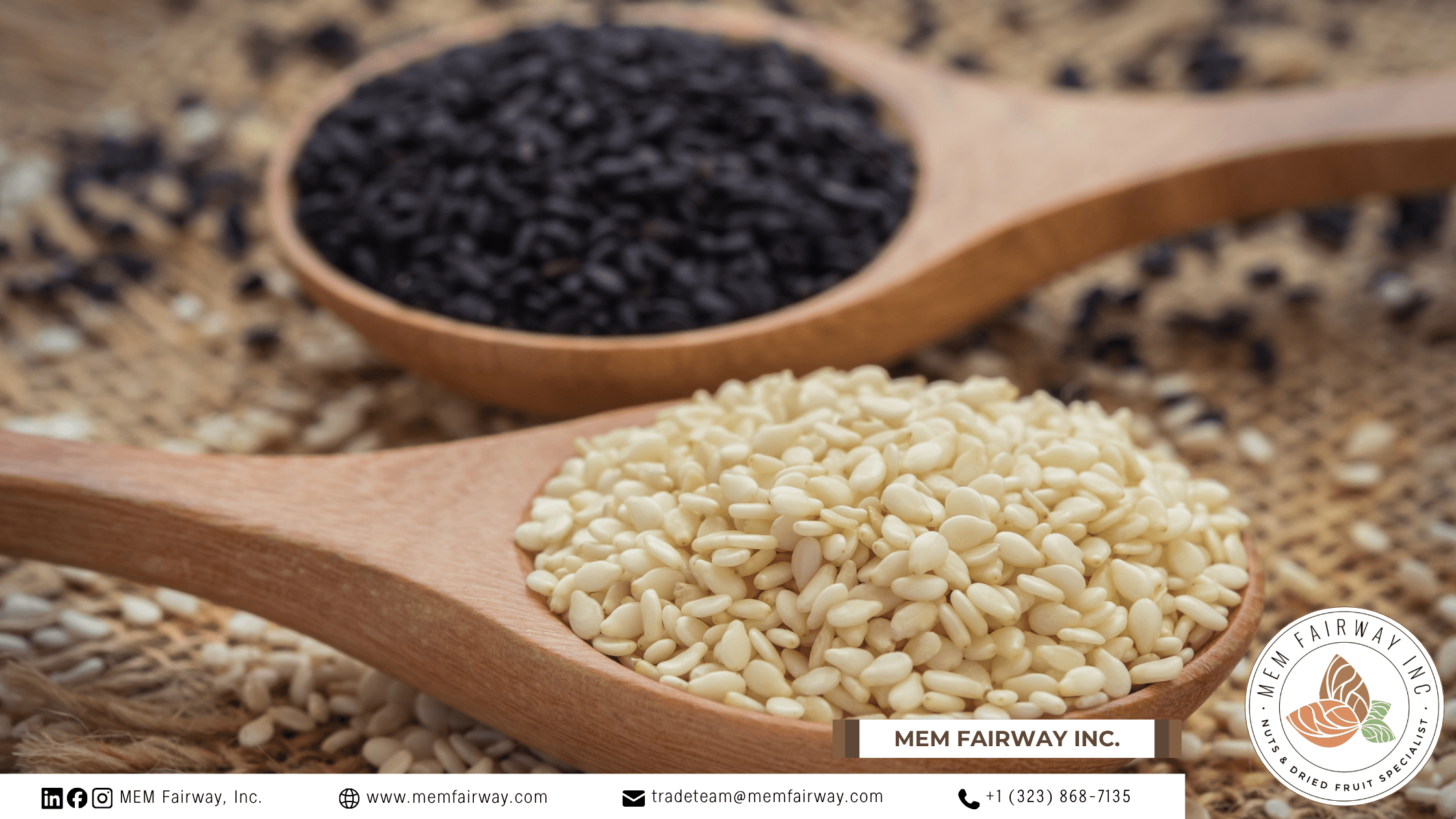
Sesame seeds are typically segmented by color and by hull status, and the distinction matters well beyond appearance. Choosing the right type is one of the most consequential decisions a buyer or processor can make, as variety and processing method determine flavor intensity, calcium content, shelf stability, and ultimately, end use.
| Variety | Key Strength | Common Use | Notable Trait |
|---|---|---|---|
| White (Hulled) | Mild flavor, market dominance | Bakery, snacks, oil extraction | Largest share of the global market, prized for its tender bite and neutral, versatile flavor. |
| White (Unhulled) | Higher fiber and calcium | Whole-food and health-focused products | Retains the outer hull, giving it a nuttier, earthier flavor and higher calcium content than hulled seed. |
| Black Sesame | Highest lignan content | East Asian confections, oil, garnish | Highest levels of sesamin and total lignans of any seed color, with a stronger, more toasted flavor profile. |
| Non-Dehiscent (Shatter-Resistant) | Mechanized harvest yield | Large-scale commercial production | Bred specifically to resist pod-shattering, dramatically reducing seed loss during mechanical harvest. |
Breeding programs have increasingly focused on developing non-dehiscent, or shatter-resistant, lines. Compared to older shattering cultivars, today’s shatter-resistant varieties greatly reduce harvest losses, a shift that has been critical to expanding commercial-scale sesame production in places like the southern United States. Newer breeding work is also targeting earlier maturity windows, which gives growers more flexibility on planting dates and access to a wider range of growing regions.
For processors and brands planning new sourcing relationships, staying current with variety trial results and regional agronomic guidance remains an important part of long-term planning.
Sesame Nutrition and Health Benefits
Beyond its role as a traded commodity, sesame’s nutritional profile is a growing part of its market story. According to USDA FoodData Central, sesame seeds are a good source of calcium, iron, magnesium, and zinc, along with healthy monounsaturated and polyunsaturated fats. This nutrient density is a key driver behind rising demand from health-conscious consumers and food manufacturers alike.
Heart Health
Sesame seeds are rich in lignans, most notably sesamin, plant compounds that a comprehensive review published by the National Institutes of Health has linked to cholesterol-lowering, lipid-regulating, and blood-pressure-stabilizing effects. In one clinical trial, people with high cholesterol who ate hulled sesame seeds daily alongside standard treatment saw meaningful reductions in cholesterol and triglycerides.
Bone Health
Sesame, especially the unhulled variety, is one of the more calcium-dense seeds available, and it also supplies magnesium, phosphorus, and zinc, minerals that work together to help maintain bone density.
Blood Sugar and Inflammation
The fiber and healthy fats in sesame seeds can help slow the absorption of sugar into the bloodstream, while their antioxidant lignans may help ease chronic, low-level inflammation, a factor researchers increasingly link to conditions like heart disease and arthritis.
Antioxidant and Immune Support
Sesame seeds contain phytosterols, plant compounds that resemble cholesterol structurally and are believed to support immune function. WebMD reports that sesame seeds have among the highest total phytosterol content of any nut or seed commonly eaten in the U.S.
Because sesame seeds are calorie-dense, these benefits are generally tied to eating them regularly in modest servings, such as a tablespoon or two a day, rather than the small garnish amounts typically used in cooking. For brands and marketers, this distinction matters: positioning sesame as a daily functional ingredient, not just a topping, is where the nutritional story adds real value.
From Field to Market
Sesame is a crop defined by resilience, history, and long-term thinking. Success in the industry, whether in production, processing, or trade, depends on understanding how these areas connect and reinforce each other. Strong field management sets the foundation; disciplined post-harvest handling preserves the value created; smart market awareness ensures it is captured; the right variety choices position an operation for sustainable success; and a clear-eyed view of the nutritional story rounds out what makes sesame worth investing in for the long haul.
The sesame industry has ancient roots. And for those who know it well, an equally promising horizon.
MEM Fairway carries sesame seeds as part of our portfolio of nuts, seeds, dried fruits, pulses, and other specialty commodities. As a California-based trading company, we connect bulk buyers with high-quality sesame sourced from a wide network of trusted suppliers around the globe, backed by the sourcing discipline, quality standards, and export-readiness this guide has covered. Whether you need consistent volume, specific grades, or a reliable long-term supply partner, our team is ready to help.
Reach out to our trade team at tradeteam@memfairway.com, or submit your inquiry through our Contact Us page to start the conversation.